
My scientific lineage
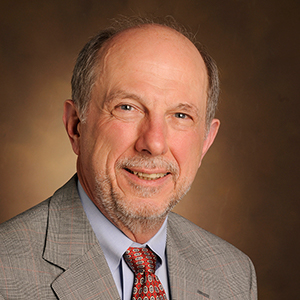
When considering scientific influences, one can talk about genealogies of background or of training. None of my own relatives were scientists, so my science lineage is composed primarily of who trained who in my academic history. In recent years, the creation of academic family trees, which trace the influence of an academic’s mentors and degrees granted at institutions, has grown in popularity. They are more common in chemistry than biochemistry, but I was curious about my own and consulted some electronic search tools (see box) that helped me put a tree together fairly easily (Fig. 1). It extends back 200 years and crosses continents.
The author pulled together his family tree from online sources, including:
The Chemical Genealogy Database
The University of Illinois
at Urbana-Champaign's genealogy resources
The University of Texas at Austin's academic genealogy of chemistry faculty
Wikipedia
The tree begins with my two outstanding mentors for my graduate and postdoctoral training, Harry “The Chief” Broquist and Minor J. “Jud” Coon. Beyond them, it branches back through a few American schools (mainly Illinois, Wisconsin and Yale) and then crosses the Atlantic Ocean to Germany and Sweden. My research gleaned interesting details about these individuals and showed me that some individuals — and institutions — can have remarkable influences in the lives of many people in this world of science.
First, let me consider the Ph.D. thesis side, beginning with Broquist, who contributed research in the areas of folic acid, lysine, carnitine and alkaloid biosynthesis. He was a Wisconsin graduate and my mentor first as an undergraduate at the University of Illinois and then in graduate school at Vanderbilt University. Broquist was a graduate student of Esmond Snell, the pre-eminent researcher in pyridoxal chemistry at the University of Wisconsin. Snell had received his Ph.D. at Wisconsin with William H. Peterson, who in turn received his Ph.D. at Wisconsin with Edwin B. Hart. Hart spent some time training in Germany in the 1890s in several labs, particularly with Nobelist L. K. M. H. Albrecht Kossel in Marburg and Heidelberg.
Hart, it seems, never received a doctoral degree, because Kossel moved from one institution to another. Nevertheless, he became a professor at Wisconsin, trained 46 Ph.D. students, and was a member of the National Academy of Sciences — achievements I do not think would all be possible today without a doctorate. Working with his student Harry Steenbock at Wisconsin, Hart determined that iodine deficiency was the cause of goiter.
Researching Kossel meant discovering links to Europe. An M.D. from Strausburg, Austria, Kossel received the Nobel Prize in physiology or medicine for his discovery of the nucleic acid bases. This is of note in light of my own interest in this area, i. e. DNA polymerases and DNA adducts.
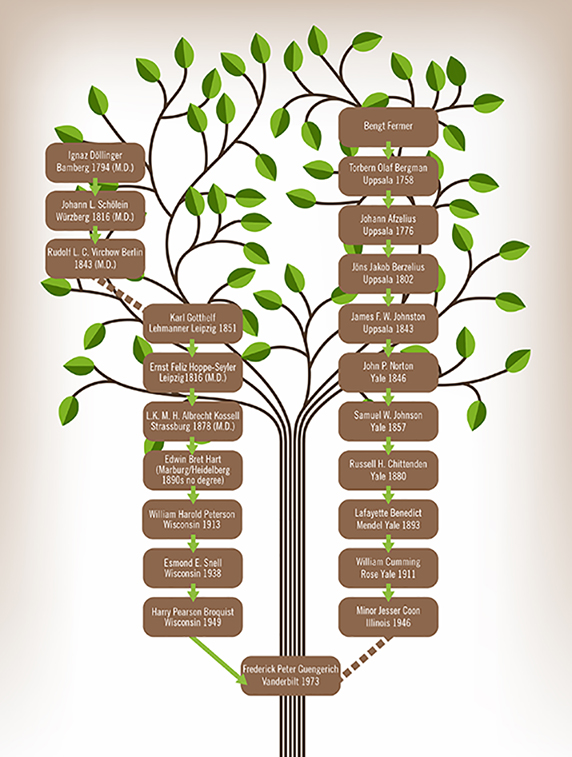 Scientific family tree of the author traced by doctoral degrees awarded. Postdoctoral links are indicated with broken lines.
Kossel was a student of Ernst F. Hoppe-Seyler (Leipzig), who may be considered one of the fathers of German biochemistry. He published extensively on hemoglobin and founded what was then the leading German biochemical journal, Hoppe–Seyler’s Zeitschrift für Physiologische Chemie, which is today published as Biological Chemistry. Hoppe–Seyler, an M.D., had trained with Lehmann in Leipzig and also later with Rudolf L. C. Virchow. Virchow, widely acclaimed as the father of modern pathology, wrote more than 2,000 papers; founded several journals; wrote textbooks; and first described the diseases leukemia, chordoma, ochronosis, embolism and thrombosis. His colleagues in Berlin referred to him as the “pope of medicine.” Virchow, in turn, trained with Johann Schölein (Berlin). Schölein was physician to Frederick William IV, discovered the cause of ringworm and named tuberculosis. He trained in Würzburg with Ignaz Döllinger, who obtained an M.D. (Würzburg) in 1794 and made early contributions to comparative anatomy.
The other side of my scientific lineage is traced through my postdoctoral adviser, Jud Coon. Coon is best known for his pioneering research in amino acid metabolism and cytochrome P450 enzymology. He received his Ph.D. from Illinois with William Rose, who discovered threonine and elucidated the requirements for amino acids in rats and humans. The American Society for Biochemistry and Molecular Biology's Rose Award is named for him. I was fortunate to receive this award in 2005, as did Coon and Snell before me.
This branch of my lineage then goes through Yale University for several generations. Rose received his Ph.D. with Lafayette Mendel, a prominent biochemical nutritionist (the American Institute of Nutrition awards the Osborne–Mendel Award each year). Mendel received his Ph.D. (Yale) with Russell Chittenden, sometimes referred to as the father of American biochemistry. Chittenden received his Ph.D. (Yale) with Samuel Johnson, a pioneering agricultural scientist, who received his Ph.D. at Yale with John Norton. Norton, also an agricultural science pioneer with a Ph.D. from Yale, trained with James Johnston.
Crossing the Atlantic on this side, now to Sweden, Johnston received a Ph.D. from Uppsala working with Jöns Jakob Berzelius, who is generally considered a father of modern chemistry, along with Robert Doyle, John Dalton and Antoine Lavoisier. He discovered the elements cerium and thorium and also developed the table of atomic weights. Another of Berzelius’s students was Friedrich Wöhler, who first synthesized urea in 1828. Thus, one can see that our biochemical ancestors were trained in medicine and chemistry; they more or less invented biochemistry.
Berzelius received his degree with Johann Afzelius (Uppsala), who had trained with Torbern Bergman, considered the first analytical chemist in Sweden.
Bergman received his Ph. D. (Uppsala) working with Bengt Ferrner, an astronomer. I was able to trace his lineage back for at least five more generations (not shown) to learned men mostly in the areas of mathematics and physics from all over Europe, including Basel, Switzerland, Leiden, the Netherlands, Jena, Germany, and Paris, France. At this time, our own field was little advanced beyond alchemy — or perhaps we should call it “albiochemy.”
A few universities dominate in my tree — Vanderbilt, Illinois, Wisconsin, Yale, Uppsala and Würzburg — and my lineage underlines the European roots of the sciences in the United States.
If one considers more details of the 20 individuals on this list (Fig. 1, not including Ferrner or me), it is really remarkable how much they contributed to science in terms of advancing the field we now call biochemistry. Chittenden was one of the founders of the ASBMB (then the American Society of Biological Chemists, or ASBC, which is what it still was when I became a member in 1978) and our first president. Mendel, Rose, Snell and Coon were also presidents of the society. Kossel was a Nobel laureate (1910). Snell, Hart, Coon, Rose, Mendel, Chittenden and Johnson were (are) members of the U.S. National Academy of Sciences.
Important applications in fields including agriculture, nutrition and drug metabolism are part of my lineage. Isaac Newton said, “If I have seen a little further, it is by standing on the shoulders of giants.” This applies here and probably to the family trees many of you will find if you ever do this. Another important point to make is that these people were undoubtedly good mentors, or this lineage would not exist. I know from firsthand experience that Broquist and Coon certainly were, and I have tried to emulate them.
This is not just boring history about some old guys. It is evidence that we should all make the most out of our opportunities in science. What we do is important in the scheme of things. Twenty people created a heritage that will last for centuries in terms of the influence they had in science and in training others to do science — science that truly matters in the lives of everyday individuals. We are not just treading water until we can collect our pensions. Individuals and institutions can make a difference in the lives of others. We can be part of a legacy that changes the world.
Enjoy reading ASBMB Today?
Become a member to receive the print edition four times a year and the digital edition monthly.
Learn moreGet the latest from ASBMB Today
Enter your email address, and we’ll send you a weekly email with recent articles, interviews and more.
Latest in Opinions
Opinions highlights or most popular articles
Learning can be fun: Gaming anatomy and physiology
Instructors explore how gamification and active learning transform student engagement and retention. They convey how emotion, interaction and design can make even rigorous subjects more effective and memorable.
Mentorship and uncertainty: Lessons from Telemachus
A biochemistry educator reflects on mentorship through the Greek story of Telemachus, showing how embracing uncertainty, failure and curiosity can transform teaching.
Embracing the twists and turns along the educator pathway
A biochemistry educator reflects on the challenges of early faculty life, describing how evidence-based teaching, cross-disciplinary collaboration and classroom challenges shaped her growth.
Redesigning with students in mind
Assistant professor reflects on how the shift to online teaching revealed gaps in points-based grading and led to a redesign centered on transparency and student growth.
Teaching beyond information transfer
Educator reflects on moving beyond lectures to create a biochemistry classroom centered on engagement, transparency and student ownership, showing how small shifts like “student hours” and active learning can transform understanding.
Mayday! Lessons from cellular dysfunction and group work dynamics
An upper-level biology course revealed that strong science doesn’t guarantee strong teamwork. One instructor shares how failed group dynamics reshaped their approach, leading to more structured, collaborative and effective student learning.